 how-to
Security Officer Training: How to Get Certified in 2026
Table of Contents
- What You'll Need Before You Enroll in Security Officer Training
- Security Guard License Requirements: Background Checks, Fingerprinting, and State Rules
- Unarmed vs. Armed Security Officer Certification: Which Path Fits Your Career
- Security Officer Training Duration: How Long Each Level Takes
- What the Training Curriculum Actually Covers
- Equipment, Gear, and Physical Fitness Standards
- Renewal Requirements and Career Advancement After Certification
- Common Mistakes to Avoid During Security Officer Training
- Frequently Asked Questions
Last Updated: September 10, 2026
What You'll Need Before You Enroll in Security Officer Training
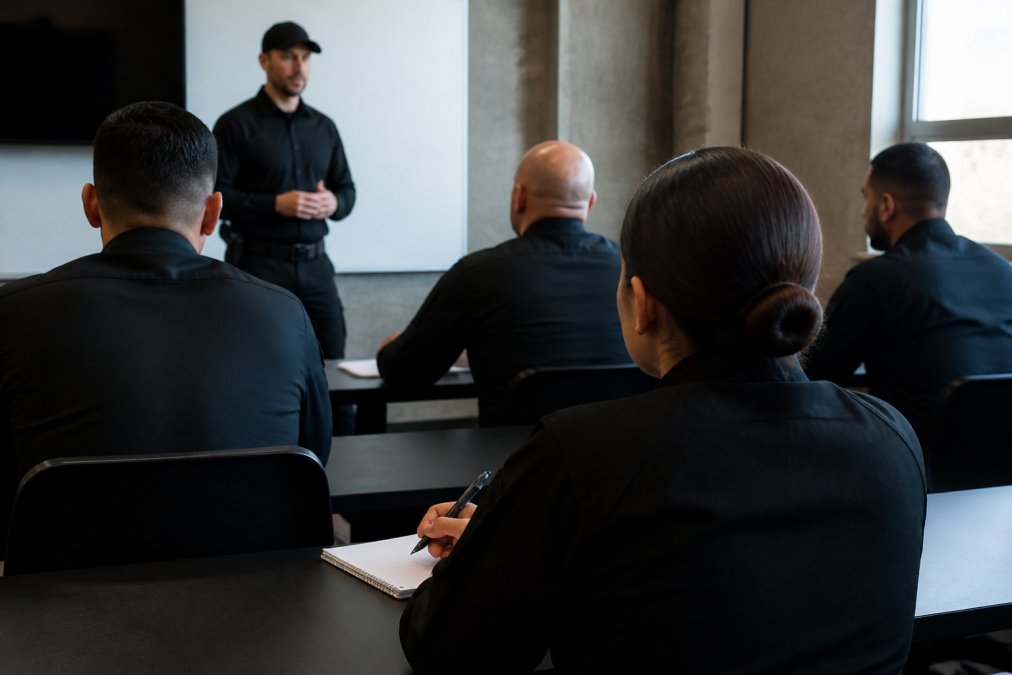
Security officer training is the state-mandated instruction that qualifies you to apply for a guard card and work legally as a licensed private security professional. Before you enroll in any certification course, you need to clear a few prerequisites that many first-time applicants overlook.
This guide walks through the full path, from background checks to renewal, so you know exactly what to expect at every stage. Most people assume the hard part is the class. It isn't. The paperwork, fingerprinting, and state approval process trip up more applicants than any exam ever will.
Here's what you need in hand before your first day of class:
- Government-issued photo ID (driver's license or state ID)
- Social Security number for the background check
- Proof of residency in the state where you'll be licensed
- Clean criminal record review (certain disqualifying offenses apply)
- Completed fingerprint card or electronic fingerprint submission
- Payment for state application and fingerprint processing fees
Security Guard License Requirements: Background Checks, Fingerprinting, and State Rules
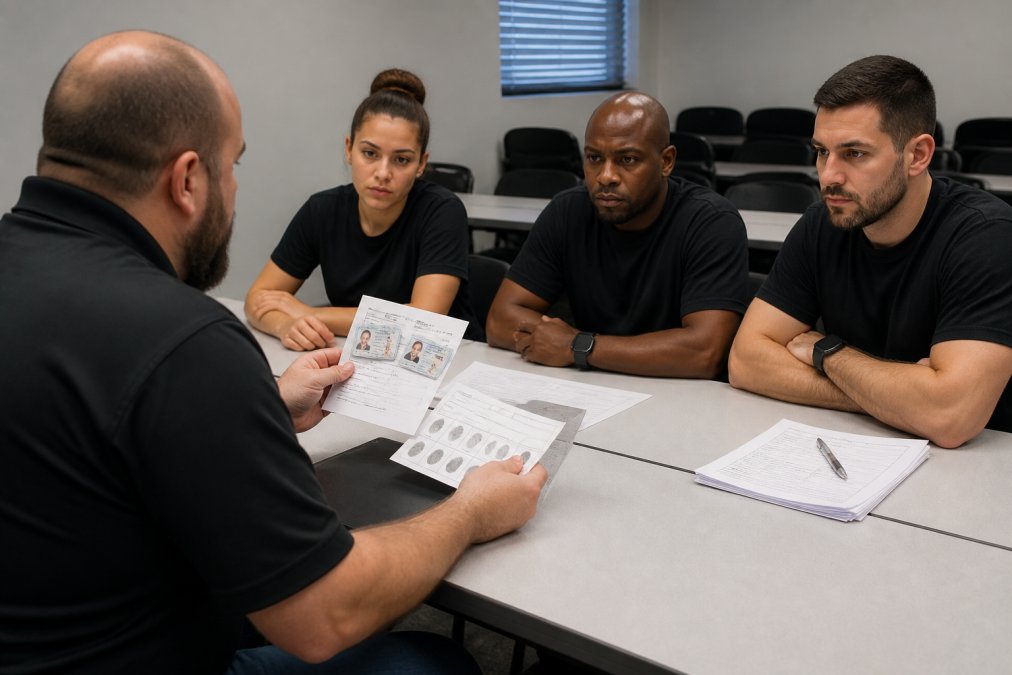
Security guard license requirements vary by state, but nearly every jurisdiction shares the same core steps: a criminal background check, fingerprinting, completion of a state-approved training course, and a formal license application. Understanding these requirements before you start saves weeks of backtracking.
The background check is the gatekeeper. States run your fingerprints through federal and state databases, and certain convictions, particularly felonies and violent misdemeanors, disqualify applicants outright. Some states allow a review process for older or minor offenses; others don't. Most licensing boards publish a disqualifying offense list, so read it before you pay for anything.
Fingerprinting is typically handled through an approved vendor or a local law enforcement agency. Many states now use live-scan electronic fingerprinting, which speeds up results and reduces rejection rates from smudged cards.
Step-by-Step State Application Guide
- Confirm you meet your state's minimum age and residency rules.
- Complete a state-approved security officer training course.
- Submit fingerprints through an approved vendor.
- File your license application with the state licensing board.
- Pay all required fees and retain your receipts.
- Wait for approval, then carry your guard card at all times on duty.
The U.S. Bureau of Labor Statistics occupational outlook for security guards outlines the broader employment picture, but your state's private security regulator is the authority on licensing specifics. Always verify current requirements directly with that office, since rules and fees change.
Unarmed vs. Armed Security Officer Certification: Which Path Fits Your Career
Unarmed security officer certification qualifies you for most entry-level guard positions, while armed security officer certification adds firearm training and a higher level of legal responsibility. The right path depends on where you want to work and how much responsibility you're prepared to carry.
Unarmed roles cover access control, patrol procedures, incident reporting, and public safety support. They're the standard entry point and the fastest route to a paycheck. Armed roles pay more and open doors to higher-risk assignments, but they demand ongoing firearms proficiency, stricter background scrutiny, and a clear understanding of legal liabilities around use of force.
If you're unsure, start unarmed. You can add armed certification later once you know the work suits you, and most states let you upgrade without repeating the entire curriculum.
What the Armed Certification Curriculum Covers
Armed certification builds on the unarmed foundation with firearm safety, marksmanship qualification, use-of-force law, and scenario-based decision training. You'll also cover de-escalation techniques under stress and proper handling and storage of your duty weapon.
Security Officer Training Duration: How Long Each Level Takes
Security officer training duration depends on the level and your state, but most unarmed programs run a matter of days while armed programs take considerably longer. Exact hour requirements are set by each state's licensing board, so check your state's published minimum before comparing courses.
| Certification Level | Typical Format | Relative Length | Best For |
|---|---|---|---|
| Level II (Unarmed) | Classroom + exam | Shortest | Entry-level guard roles |
| Level III (Armed) | Classroom + range | Moderate | Armed patrol, higher pay |
| Level IV (Personal Protection) | Advanced coursework | Longest | Executive protection work |
Self-Paced Learning vs. In-Person Classes
Self-paced learning lets you complete the classroom portion online and schedule range time separately, which suits working adults. In-person classes move faster and give you direct instructor feedback, which matters most for the hands-on and judgment components of armed certification.
If you work full time, ask any provider whether evening or weekend sessions are available before you commit. The Texas Department of Public Safety regulates private security licensing in the state, and its published requirements are the ones that govern what a course must include.
What the Training Curriculum Actually Covers
The training curriculum for security officers combines classroom instruction with practical drills, and the specific modules are set by state regulators. A typical unarmed course runs roughly 8 to 40 hours depending on the state, while armed certification adds range time and legal instruction on top of that base (bls.gov). Here's what the modules actually look like, and how each one is evaluated:
- Security protocols and patrol procedures, foot patrol patterns, post orders, and access control for commercial, residential, and industrial sites. Tested through scenario walkthroughs and a written exam.
- Emergency response and evacuation coordination, fire drill support, medical emergency notification, and crowd movement. Tested through tabletop scenarios.
- De-escalation techniques, verbal judo, distance management, and recognizing pre-assault indicators. Tested through role-play with an instructor playing an agitated subject.
- Incident reporting and documentation, narrative writing, chain of custody, and the difference between observation and inference. Tested through written reports graded on clarity and legal defensibility.
- Surveillance and access control systems, CCTV monitoring, visitor logs, and badge systems. Tested through system walkthroughs.
- Legal liabilities and limits of authority, citizen's arrest boundaries, use-of-force law, and premises liability. Tested through a written exam; this is the module most likely to fail a candidate who skims it.
Regulatory compliance sits at the center of all of it. A guard who acts outside their legal authority creates liability for themselves and their employer, which is why the legal module isn't filler.
How the Certificate Becomes a License
This is the step most course providers skip. Finishing the class earns you a certificate of completion, not a guard card. The certificate is one exhibit in a state application packet that typically also includes your fingerprint results, a passport-style photo, proof of residency, and a fee. In most states you file that packet with the private security regulator (often a division of the state police or department of public safety), and the license is mailed or made available electronically after the background check clears. Until that card is in your hand, you are not licensed to work, even if you passed the class with a perfect score.
Equipment, Gear, and Physical Fitness Standards
Most states don't impose strict physical fitness standards for unarmed guards, but the job itself demands a baseline: you need to stand for long shifts, walk patrol routes, and respond quickly in an emergency. Armed roles and executive protection assignments raise that bar, and some employers run their own fitness screening, typically a timed walk, a stair climb, or a lift-and-carry test rather than a formal PT exam.
Standard equipment typically includes a uniform, duty belt, flashlight, and radio. Armed officers add a holster, secure duty weapon, and often body armor. Some employers issue gear; others expect you to buy it. Confirm before your first shift so you're not caught short.
What Gear Actually Costs Out of Pocket
If your employer doesn't issue gear, budget for the following categories. Prices vary by brand and region, but the ranges below reflect what new officers commonly report paying:
- Uniform shirts and trousers, a two-set starter kit typically runs $80 to $200 depending on whether the employer requires a specific color or logo.
- Duty belt and pouches, $40 to $120 for a nylon or leather belt with handcuff, radio, and flashlight pouches.
- Duty flashlight, $30 to $100; a rechargeable model saves money over disposable batteries.
- Two-way radio, often issued by the employer; if not, $60 to $200 for a basic UHF handheld.
- Body armor (armed roles), $300 to $800 for a concealable vest; some employers require it and some reimburse part of the cost.
- Holster and duty weapon (armed roles), the weapon itself is usually purchased personally and can run $400 to $700 for a common duty pistol, plus $50 to $150 for a quality holster.
Total out-of-pocket for an unarmed starter kit usually lands between $150 and $400. Armed officers should expect to spend considerably more, and should ask whether the employer reimburses any of it.
Physical Readiness: What Employers Actually Screen For
A common pattern in hiring is a functional screen rather than a fitness test. Expect to demonstrate that you can:
- Stand and walk for a full 8- to 12-hour shift without accommodation
- Climb stairs and walk a patrol route at a brisk pace
- Lift and carry 50 pounds (a common threshold for fire watch and industrial posts)
- Respond to a radio call and move to a location quickly
Some executive protection and armed patrol employers add a timed run or a defensive tactics assessment. If you're targeting those roles, train for them before you apply, the screen is usually pass/fail and not negotiable.
Renewal Requirements and Career Advancement After Certification
Renewal requirements mean your guard card isn't permanent. Most states require periodic renewal, and some mandate continuing education or recertification before you can renew. Missing a renewal deadline can leave you working without a valid license, which carries real legal consequences.
Career advancement after certification follows a fairly predictable ladder. Unarmed guards move into armed roles, then into supervisory or site-management positions, and eventually into executive protection or specialized assignments. Each step usually requires additional training and a clean record.
Security officer training isn't a one-time box to check. Treat it as the start of ongoing professional development.
Common Mistakes to Avoid During Security Officer Training
The biggest mistakes during security officer training happen before the course even starts: enrolling without checking eligibility, choosing a provider that isn't state-approved, and treating the legal module as something to skim.
Other frequent errors:
- Skipping the fingerprinting step until after the course, which delays the whole application
- Assuming a certificate alone equals a license (it doesn't, you still must apply)
- Letting a renewal deadline slip and working on an expired card
- Underestimating the judgment and de-escalation components of armed certification
A state-approved provider handles the training correctly, but the application and renewal steps are on you. Track your own deadlines.
Getting certified is only half the job. Staying compliant, renewing on time, and building the judgment that keeps you and the public safe is the part that separates a guard card from a career. Corsair Tactical Solutions, a veteran-owned and led firm with over 14 years of instructing experience, provides state-certified Level II, III, and IV security officer training and professional security services, backed by a proven 4D Protection Model™ and a 5.0 average rating across more than 500 students trained. Our team is licensed, bonded, and insured, and we build training around the real scenarios guards face on duty. Schedule a consultation with Corsair Tactical Solutions to map out your certification path and get started.
Frequently Asked Questions
What training is required for security officers?
Most states require completion of a state-approved certification course before you can work. Entry-level unarmed training typically covers patrol procedures, incident reporting, emergency response, de-escalation techniques, and legal liabilities. Armed certification adds firearms qualification, use-of-force rules, and additional range hours. You also need a clean background check and fingerprinting. Requirements vary by state, so confirm the specific training hours your licensing board mandates before enrolling in any security officer training program.
How long does it take to complete security officer training?
Security officer training duration depends on the level. Unarmed certification can often be finished in a few days or over several weekends. Armed certification typically requires additional range time. Some providers offer self-paced learning, letting you complete coursework around a full-time job. Ask whether evening or weekend classes are available if you cannot take consecutive weekdays off work.
What is the difference between armed and unarmed security officer training?
Unarmed training prepares you for access control, surveillance, patrol procedures, and incident reporting without carrying a firearm. Armed security officer certification adds firearms handling, marksmanship qualification, use-of-force decision-making, and legal liabilities specific to carrying a weapon on duty. Armed roles typically pay more but require a higher level of clearance, more training hours, and periodic requalification. Choose your path based on the job sites you want to work and your comfort level with firearms.
Do I need to renew my security officer certification periodically?
Yes. Most states require recertification every one to three years. Renewal requirements usually include refresher coursework, a new background check, and, for armed officers, a firearms requalification at a range. Some states also require continuing education hours. Missing a renewal deadline can leave you unable to work legally, so track your expiration date. Your training provider or state licensing board can confirm the exact renewal requirements and deadlines for your certification level.