 how-to
Level 3 Security Guard Training in Texas: 2026 Guide
Table of Contents
- What Level 3 Certification Allows You to Do
- DPS Private Security Requirements for Level 3 Applicants
- Level 3 Firearm Proficiency Requirements and Course of Fire
- Armed Security Officer Training Duration and Class Formats
- Level 3 Security Guard Training in Texas: Step-by-Step Licensing Timeline
- Common Reasons Applications Get Denied (and How to Avoid Them)
- Career Path and Salary Expectations After Level 3 Security Guard Training in Texas
- Frequently Asked Questions
Last Updated: September 24, 2026
What Level 3 Certification Allows You to Do
Level 3 security guard training in Texas turns a licensed officer into an armed professional with real authority. This guide from Corsair Tactical Solutions breaks down every requirement you'll face before you carry a duty firearm.
The Level 3 security guard training pathway is the armed commission.
What you can do with a Level 3 commission:
- Work armed security posts at banks, hospitals, and retail sites
- Provide armed patrol for commercial and residential properties
- Qualify for personal protection officer assignments
- Command higher hourly rates than non-commissioned officers
DPS Private Security Requirements for Level 3 Applicants
DPS private security requirements start with one non-negotiable rule: you must already hold a valid Level 2 non-commissioned license. The state does not let you skip straight to armed certification.
Basic eligibility rules for Level 3 applicants:
- Be at least 21 years old for armed commission
- Hold a current Level 2 license in good standing
- Pass a fingerprint-based background check
- Complete the MMPI psychological evaluation
- Have no disqualifying criminal history
Level 3 Firearm Proficiency Requirements and Course of Fire
Level 3 firearm proficiency requirements center on one thing: proving you can safely handle and shoot a duty weapon under pressure. The state sets a minimum training hour requirement plus a live range qualification.
Typical course of fire elements:
- Shooting from standing and kneeling positions
- Timed strings of fire at set distances
- Reloading under time pressure
- Clearing a firearm malfunction safely
- Demonstrating muzzle discipline at all times
Armed Security Officer Training Duration and Class Formats
Armed security officer training duration varies by provider, but the state sets a minimum training hour requirement you cannot shorten. Most students finish the classroom and range portion in a few days, then wait on licensing paperwork.
Class formats generally fall into four options:
Online Classroom option
- Weekday classroom blocks for full-time students
- Evening sessions spread across several weeks
- Weekend intensives for working adults
Format | Best For | Typical Schedule |
|---|---|---|
Weekday block | Full-time students | Consecutive days |
Evening sessions | Working adults | Multiple Days |
Weekend intensive | Tight schedules | Two weekends |
Level 3 Security Guard Training in Texas: Step-by-Step Licensing Timeline
Phase 1, Confirm eligibility (before you pay for anything)
- Verify your Level 2 non-commissioned license is active and in good standing with the Private Security Bureau. An expired or suspended Level 2 blocks the Level 3 application outright.
- Confirm you are at least 21 and have no disqualifying criminal history. Run your own background check first, it is cheaper than a denied application.
Phase 2, Training and testing (provider-controlled)
- Enroll in a DPS-approved Level 3 course. The classroom block covers use of force, legal liability, and defensive tactics; the range block covers the course of fire.
- Pass the written examination. This is a knowledge check on law and liability, not a shooting test.
- Pass the range qualification. A single safety violation ends the day, see the firearm proficiency section above.
Phase 3, State-side requirements (the long pole)
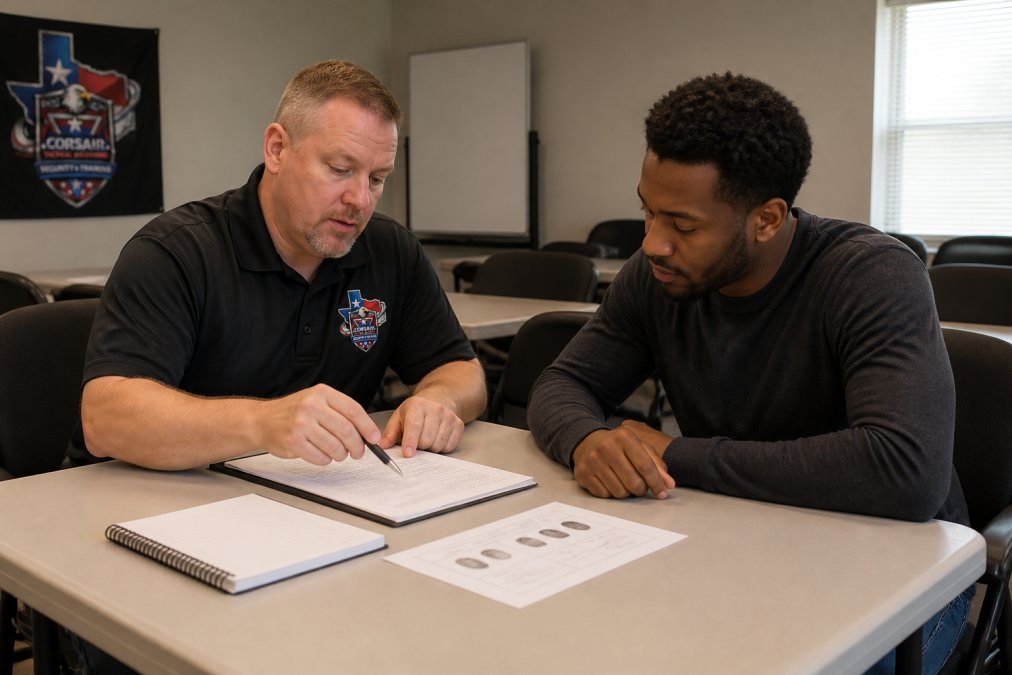
- Submit fingerprints through the state's approved vendor. The submission routes to both the state repository and the FBI database, so results are not instant.
- Complete the MMPI psychological evaluation with a qualified provider. Results are sent directly to the state, not handed to you.
- Your employer or training provider files the application packet with the department.
- The department reviews the packet, runs the background check, and issues the armed commission.
Phase 4, After issuance
- Requalify on the schedule the state sets for armed officers. Let the requalification window lapse and your armed commission is no longer valid for duty.
Where the delays actually happen
What you can do to compress the timeline
- Gather your identification documents and prior-address history before you enroll, so the background check is not delayed by missing information.
- Ask your provider which fingerprint vendor the state currently approves, and book the appointment the same week you enroll.
- Schedule the MMPI with a provider who has done armed-security evaluations before; unfamiliar providers sometimes submit incomplete packets.
- Keep copies of every receipt, form, and confirmation. If the state flags a missing item, you can respond the same day instead of restarting the search.
Common Reasons Applications Get Denied (and How to Avoid Them)
Application denials almost always trace back to a small set of issues, and most of them are fixable if you catch them before you file. The key distinction is between permanent disqualifiers, which end the process, and curable defects, which you can correct and refile.
Permanent disqualifiers
- A felony conviction, or a misdemeanor conviction that the state classifies as disqualifying for a commissioned officer.
- A dishonorable discharge from the military.
- A court finding of mental incompetence or an involuntary commitment that the state treats as disqualifying.
- A chemical dependency diagnosis that has not been addressed through an approved treatment program.
Curable defects (the ones that actually cost people months)
- Undisclosed criminal history. The single most common denial driver. The state pulls records from every jurisdiction you have lived in, so an old charge you forgot about will surface. Disclose everything on the application, even incidents that were dismissed or expunged, the state would rather see a disclosed incident than a hidden one.
- Incomplete or expired fingerprint submission. Fingerprint cards and electronic submissions have a shelf life. If yours expires before the state reviews your packet, the whole application stalls.
- A failed or missing MMPI evaluation. The MMPI is a validity test, not just a personality test. Answering inconsistently or trying to game the results produces an invalid profile, which the state treats as a failure.
- An unsafe range performance. A safety violation during the course of fire fails the qualification, and a failed qualification means no training certificate to attach to the application.
- Paperwork errors. Missing signatures, wrong form versions, or an application filed by an employer who is not authorized to file on your behalf.
How to avoid each one
- Pull your own criminal history from every state you have lived in before you apply. Disclose anything that appears.
- Submit fingerprints early and confirm the vendor is on the state's current approved list.
- Take the MMPI seriously and answer honestly; do not try to predict the "right" answer.
- Treat every range command as final. Slow is smooth, smooth is fast.
- Review the packet with your training provider before it is filed, and keep a copy of everything you submit.
If you are denied
Career Path and Salary Expectations After Level 3 Security Guard Training in Texas
Career options open up fast once you hold the armed commission. Level 3 officers qualify for posts that non-commissioned officers cannot touch, and those posts pay more.
Paths armed officers commonly pursue:
- Armed site security at banks, hospitals, and data centers
- Armed patrol for commercial and residential properties
- Executive protection and personal protection officer work
- Supervisory roles overseeing non-commissioned teams
Frequently Asked Questions
How long does the Level 3 security guard course take?
The state requires a minimum of 30 hours of classroom instruction plus range time for firearm qualification. In practice, most students finish over two to three days of full-day sessions, or across several evenings and weekends. Part of the armed security officer training duration is the range portion, which depends on how quickly you meet the proficiency standard. Ask your provider for the exact schedule before you enroll.
Do I need to pass a shooting proficiency test for Level 3 certification?
Yes. You must pass a handgun proficiency test and a written exam to earn the Level 3 armed security license. The shooting test is scored pass or fail, and you must demonstrate safe handling, accuracy, and proper technique throughout the course of fire. If you do not pass, most providers allow a retake. Failing the written examination means you repeat that portion before the state processes your certification.
What is the difference between Level 2 and Level 3 security licenses?
A Level 2 non-commissioned license lets you work unarmed security jobs such as access control, patrol, and crowd monitoring. A Level 3 armed security license adds the legal authority to carry a firearm on duty, which requires the additional training hours, firearm proficiency requirements, and a higher level of legal liability. Many officers start at Level 2 and upgrade to Level 3 once they have a sponsor and range experience.
What can a Level 3 security guard carry in Texas?
A Level 3 officer may carry a firearm on duty, but only the specific weapon they qualified with during training, and only while employed by a licensed security company. You cannot carry a different firearm than the one listed on your certification. Some officers also carry defensive tactics tools like handcuffs after completing the required training. Personal protection officer duties fall under a separate Level 4 certification.
How much does a level 3 security guard make in Texas?
Pay varies by employer, shift, and location, but armed officers typically earn more than unarmed guards because of the added training and liability. Overnight shifts, high-risk posts, and sites requiring personal protection officer credentials often pay the most. The most reliable way to compare offers is to ask each employer about their starting rate, shift differentials, and whether they cover continuing education and requalification costs.