 ultimate-guide
How to Improve Church Security: A Complete Guide
Table of Contents
- Why Church Security Matters: Understanding the Landscape
- Conducting a Church Security Risk Assessment
- Developing a Church Security Team and Training Program
- Implementing Physical Security Infrastructure
- Deploying an Armed Security Team for Church Protection
- Creating a Church Safety and Security Manual Template
- Emergency Response Planning and Legal Compliance
- Frequently Asked Questions
Last Updated: September 28, 2026
Why Church Security Matters: Understanding the Landscape
Active incidents at religious institutions have prompted church leadership to rethink how to improve church security from the ground up. It's about building layered defenses that deter threats, detect intrusions early, and enable decisive response.
Most churches lack formal security plans and respond reactively to incidents. Improving church security doesn't require massive budgets, it requires strategy, training, and commitment.
Conducting a Church Security Risk Assessment
A vulnerability assessment is the foundation of any serious security program.
Map your facility and document every entry point: main doors, side exits, windows, parking areas, and roof access. Walk the perimeter at different times of day, a door secure during Sunday service might be propped open during Wednesday activities.
Evaluate current protocols: How do greeters identify who belongs? What happens if someone becomes disruptive? How quickly can staff communicate during emergencies?
Document findings in a written risk assessment and prioritize by likelihood and impact. A broken lock on a rarely-used side door ranks lower than inadequate communication systems. This prioritization drives spending decisions and training focus.
Developing a Church Security Team and Training Program
A trained security team transforms your congregation from passive to prepared. This isn't about armed guards in corners, it's about trained volunteers and staff who understand situational awareness, de-escalation, and emergency response.
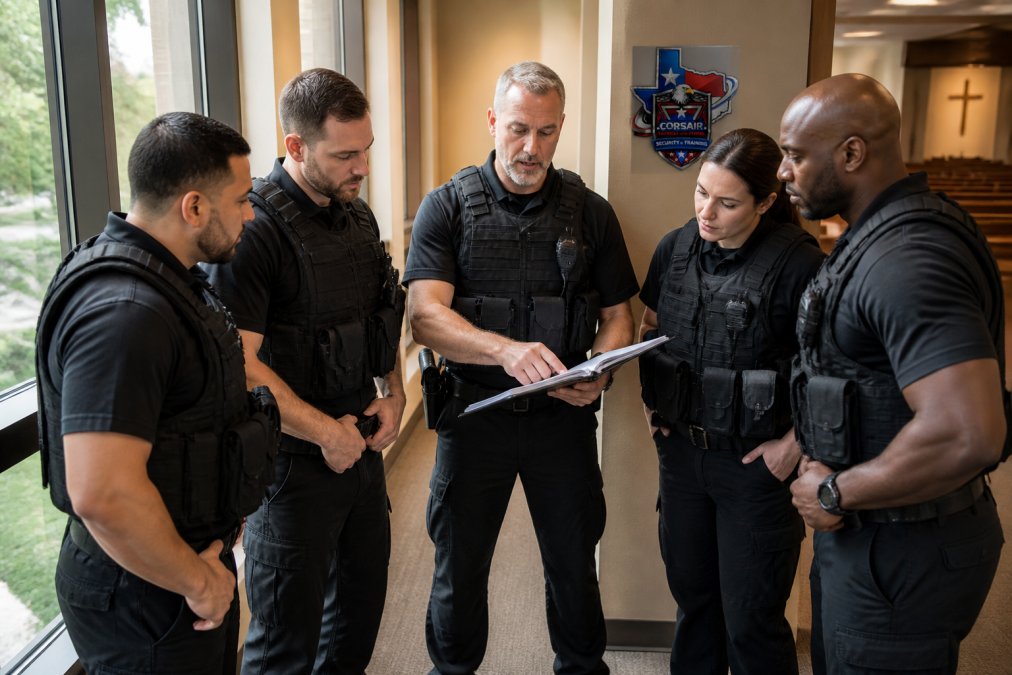
Identify team members representing different ages and physical capabilities. Structure your team with clear roles: assign a security director who owns the program, designate team leads for different areas, and create a communication protocol for reporting concerns.
De-Escalation Training: The First Line of Defense
De-escalation is the skill most churches overlook and most need. Most disruptive incidents involve individuals experiencing mental health crises, substance abuse, or emotional distress. De-escalation training teaches your team to defuse tension before it becomes a security incident.
Core techniques include:
Verbal de-escalation: Use a calm, measured tone. Instead of "You need to leave," try "I want to help you. Can we talk about what's happening?" Acknowledge emotional states: "I can see you're upset. I'm here to listen."
Spatial awareness: Maintain 6-10 feet distance at an angle rather than directly facing the person. Never block exits. Keep hands visible and open.
Active listening: Ask open-ended questions and listen without interrupting. People who feel heard are less likely to escalate.
Redirecting focus: Redirect attention with "Let's step over here where it's quieter" or "Can I get you some water?" to interrupt the escalation cycle.
Knowing when to disengage: Train your team to recognize when a person is becoming more agitated despite their efforts. At that point, the goal shifts to creating distance and calling for help.
Mental Health and Crisis Intervention
Your security team should recognize signs of mental illness, substance abuse, or acute distress and respond with compassion rather than enforcement.
Common presentations include acute psychiatric episodes, substance intoxication or withdrawal, homelessness, and grief or emotional crisis.
Train your team to respond by offering help: "I'm concerned about your safety. Can I help you connect with resources?" If the person is a danger to themselves or others, contact 911 with specific information.
Consider establishing relationships with local mental health crisis teams or mobile crisis units. Having their contact information and understanding their protocols strengthens your response.
Training Schedule and Competency Standards
Baseline training should cover threat recognition, de-escalation, emergency procedures, and mental health awareness before anyone takes on a security role.
Quarterly refresher training with role-play exercises keeps skills sharp. Your security director and team leads should pursue recognized credentials. Document all training to protect your organization.
Implementing Physical Security Infrastructure
Physical security infrastructure deters threats and buys time for response through access control, surveillance, door hardware, and perimeter security.
Begin with access control: locked doors during services with designated greeters, or electronic locks on administrative areas.
Replace hollow-core doors on sensitive areas with solid-core or metal doors. Install quality locks and hinges to slow intrusion.
Position cameras at entry points, parking areas, and common spaces. Ensure footage is backed up securely and retained according to your policies.
Perimeter security, fencing, lighting, landscaping, shapes approach to your building. Clear sightlines reduce hiding spots. Good lighting deters intrusions. Maintained landscaping prevents concealment near windows.
Deploying an Armed Security Team for Church Protection
An armed security team requires careful consideration of liability, training standards, and alignment with your congregation's values.
Armed security personnel need professional-level training in threat assessment, weapons handling, de-escalation, and use-of-force decision-making, plus understanding of state legal frameworks and regular recertification.
Uniformed officers provide visible deterrence and clear identification during emergencies. Most churches benefit from a mix of uniformed and plainclothes personnel.
Your armed team needs clear rules of engagement: when to draw a weapon, proportional force levels, and communication with law enforcement.
Corsair Tactical Solutions provides armed security personnel. Our officers understand the sensitivity of the environment and the need for proportional response. They're licensed, bonded, and insured.
Creating a Church Safety and Security Manual Template
A church safety and security manual documents policies, procedures, and expectations as a reference guide during incidents and training tool.
Your manual should be practical and specific to your congregation's size and resources.
Core Sections Every Manual Needs
1. Threat Recognition and Reporting Procedures
2. De-Escalation and Conflict Resolution Protocols
3. Mental Health Crisis Response
4. Emergency Evacuation and Shelter-in-Place Procedures
Provide step-by-step instructions for different scenarios:
Active threat: Alert staff, evacuate to designated exits if safe (or shelter in place and lock doors), move to predetermined assembly point, account for all people, do not re-enter.
5. Access Control and Visitor Management
6. Incident Documentation and Reporting
Create a simple incident report form including:
- Date, time, location
- Who was involved (names if known, descriptions if not)
- What happened (specific facts, not interpretation)
- Who responded and what actions were taken
- Were emergency services called? (Yes/No, which agency)
- Injuries or damage
- Follow-up needed (yes/no, what kind)
7. Coordination with Law Enforcement
Include contact information:
- Emergency (911)
- Local police non-emergency line
- Specific officer or community liaison if you have an established relationship
8. Training and Certification Requirements
Specify what training each role requires:
- All volunteers: Threat recognition and de-escalation (annual)
- Security team members: Threat recognition, de-escalation, emergency procedures, mental health awareness (initial training + quarterly refreshers)
- Security director: All of the above plus incident command, coordination with law enforcement, legal compliance (initial training + annual refreshers)
- Armed security personnel: Professional-level training in weapons handling, use-of-force decision-making, de-escalation, and legal framework (initial certification + annual recertification)
9. Regular Drills and Plan Updates
Tailoring Your Manual to Your Congregation's Size
Small congregations (under 200 members):
Keep procedures simple. Focus on threat recognition, de-escalation, and clear communication. Emphasize relationships: knowing your congregation and being alert to changes in behavior or new faces.
Medium congregations (200-800 members):
Large congregations (800+ members):
Making Your Manual Accessible
Write procedures in clear, actionable language. "If someone enters the nursery without signing in, politely ask them who they're looking for. If they can't name a child or staff member, notify the nursery director immediately" is actionable.
Emergency Response Planning and Legal Compliance
Emergency response planning ensures your team knows how to act during critical moments. Legal compliance ensures those actions don't expose your organization to liability.
Frequently Asked Questions
What are the first steps to improve church security?
Start with a vulnerability assessment of your facility, identifying entry points, blind spots, and potential risks. Next, establish a security team with clear roles and responsibilities, develop communication protocols, and create an emergency response plan. Document your findings in a written security policy. Many congregations begin with access control improvements and staff awareness training before investing in technology or armed personnel.
How do I build an effective church security team?
Select team members with a mix of backgrounds, law enforcement experience is valuable but not required. Provide formal church security team training covering threat recognition, de-escalation, emergency procedures, and communication. Establish clear protocols for different scenarios, assign specific roles (greeters, monitors, responders), and conduct regular drills. Ensure your team understands the balance between welcoming congregants and maintaining situational awareness.
What should a church safety and security manual template include?
A comprehensive church safety and security manual template should cover threat assessment procedures, access control policies, staff and volunteer roles, emergency response protocols, evacuation procedures, active shooter response, incident reporting requirements, communication trees, and training schedules. Include specific details about your facility layout, emergency contacts, and decision-making authority. Review and update the manual annually or after any security incident.
When should a church hire an armed security team?
Consider an armed security team for church protection. Ensure any armed security team complies with state law, carries proper licensing and insurance, and receives ongoing training. Verify background checks and credentials. For smaller congregations, unarmed security with law enforcement coordination may be sufficient.
What legal liability do churches face regarding security?
Churches have a duty of care to protect congregants from foreseeable harm. Liability exposure increases if security vulnerabilities are known but unaddressed. Proper documentation of your risk assessment, written safety policies, staff training, and incident reporting protects against negligence claims. Consult with your insurance provider and legal counsel about coverage requirements and compliance obligations specific to your facility and state regulations.
How often should we conduct security training and drills?
Conduct formal security team training at least twice annually, with quarterly refresher sessions. Run tabletop drills annually and full-facility evacuation drills every 6-12 months. Brief all staff and volunteers on basic threat awareness and evacuation procedures during onboarding. After any security incident or policy change, provide immediate retraining. Regular drills normalize emergency procedures and identify gaps in your response plan.
Can small churches afford professional security improvements?
Yes. Start with low-cost, high-impact changes: improved lighting, door hardware upgrades, clear access control policies, and volunteer team training. Many congregations begin with unarmed security and surveillance systems before considering armed personnel. Prioritize based on your vulnerability assessment results. Professional consultation helps identify which improvements deliver the most protection for your budget and congregation size.