 how-to
How to Get a License to Carry in Texas
Table of Contents
- Do You Need a License to Carry in Texas?
- Texas LTC Requirements and Eligibility Criteria
- How Long Is the Texas LTC Course and What It Covers
- Constitutional Carry vs. License to Carry in Texas
- Step-by-Step Application Process for Your License to Carry
- Common Mistakes to Avoid When Applying
- Getting Certified Training Near You
- Frequently Asked Questions
Last Updated: September 18, 2026
Do You Need a License to Carry in Texas?
Texas changed its firearm laws in 2021 (87(R) HB 1927 - Engrossed version). The state now allows constitutional carry, meaning you can carry a handgun without a license. But there's a catch: a license to carry still matters for many situations.
A license to carry Texas gives you legal authority to carry a concealed handgun in public. Even with constitutional carry in place, getting one protects you. You can carry across state lines. You avoid background check delays at gun shops. You gain legal clarity in gray areas.
Many gun owners still pursue a license to carry. It's the responsible choice. At Corsair Tactical Solutions, we've trained over 500 students in Texas LTC certification. Our instructors understand the real-world reasons why a license matters beyond the law.
The process takes time but it's straightforward. Below, we'll walk you through every step, from eligibility through approval.
Texas LTC Requirements and Eligibility Criteria
To qualify for a license to carry Texas, you must meet specific criteria set by Texas law. Not everyone is eligible.
You must be at least 21 years old. Some exceptions exist for active military members and certain law enforcement personnel (age 18 and up). You need to be a Texas resident or active military stationed in Texas.
You cannot have certain criminal convictions. Felonies disqualify you. So do convictions for crimes of violence, assault, or domestic violence. Restraining orders against you also block approval. If you've been committed to a mental health facility or adjudicated mentally ill, you're ineligible.
Drug offenses matter. Any felony drug conviction ends your eligibility. Misdemeanor drug possession within the last two years also disqualifies you.
You must not be subject to a protective order. Court orders related to family violence, stalking, or harassment block your application. You also cannot be currently charged with a crime that would disqualify you if convicted.
Eligibility checklist:
- Age 21 or older (18 if active military)
- Texas resident or active military in Texas
- No felony convictions
- No violent crime convictions
- No domestic violence history
- No active protective orders
- No recent drug convictions
- No mental health adjudication
If you meet these criteria, you're eligible to apply. The next step is training.
How Long Is the Texas LTC Course and What It Covers
Texas requires certified training before you apply. The course teaches firearm fundamentals and legal responsibilities.
The minimum training is four to six hours. Most courses run one full day. You'll learn in a classroom and on the range.
The course covers firearm safety first. You'll learn how to handle, load, and unload a handgun safely. Instructors teach you the mechanics of different pistol types. You practice proper grip, stance, and sight alignment.
Legal instruction is mandatory. You'll study Texas Penal Code sections on justified use of force. You learn when you can legally draw and when you can fire. The course explains when self-defense applies and when it doesn't. You study laws on carrying in specific locations, schools, government buildings, private property.
Range time is essential. You'll fire your handgun under supervision. Most courses require you to hit a target at 7 and 15 yards. You don't need to be an expert shot. You need to demonstrate basic competency and safe handling.
Instructors also cover storage and responsibility. You learn how to secure your firearm at home. The course discusses liability and when you might face legal consequences for misuse.
Most people complete the course in one day. You receive a certificate of completion. This certificate is your ticket to apply for your license.
Corsair Tactical Solutions offers Texas DPS-certified training. Our instructors have 14+ years of experience. We teach the law clearly and the range skills practically. Many students complete our course and move directly to the application step.
Constitutional Carry vs. License to Carry in Texas
Texas allows constitutional carry as of September 2021 (87(R) HB 1927 - Engrossed version). This means you can carry a handgun without a license. The Second Amendment permits it. Texas law now recognizes that right.
But constitutional carry doesn't eliminate the license. The license to carry still exists. It serves different purposes.
Constitutional carry lets you carry openly or concealed without permission. You don't need to apply. You don't need training. You don't need a background check through the licensing system. You simply carry.
License to carry is optional but valuable. You choose to get one. You complete training. You pass a background check. You get a card that proves your status.
Why get a license if constitutional carry exists? Several reasons stand out.
Interstate travel is the biggest one. Your Texas license is recognized in other states. Constitutional carry only works in Texas. If you travel to another state, a Texas LTC gives you legal protection.
Background check delays disappear. When you buy a gun, the dealer runs a background check. With a license, you skip that wait. You show your LTC card and walk out same day.
Reciprocity matters for your rights. Some states honor Texas licenses but not constitutional carry. Your license opens doors that carrying without one doesn't.
Private property access is clearer. Business owners can set rules about guns on their property. A license shows you've had formal training and passed a background check. Some property owners feel more comfortable with licensed carriers.
Legal clarity in gray situations helps. If you're stopped by police, a license explains your status immediately. You're not arguing about whether you have the right to carry. You have documentation.
Most serious gun owners get a license. The training is valuable. The protection it offers is real.
Step-by-Step Application Process for Your License to Carry
Getting your license involves four main steps: training, documentation, application, and waiting. Here's exactly what to do.
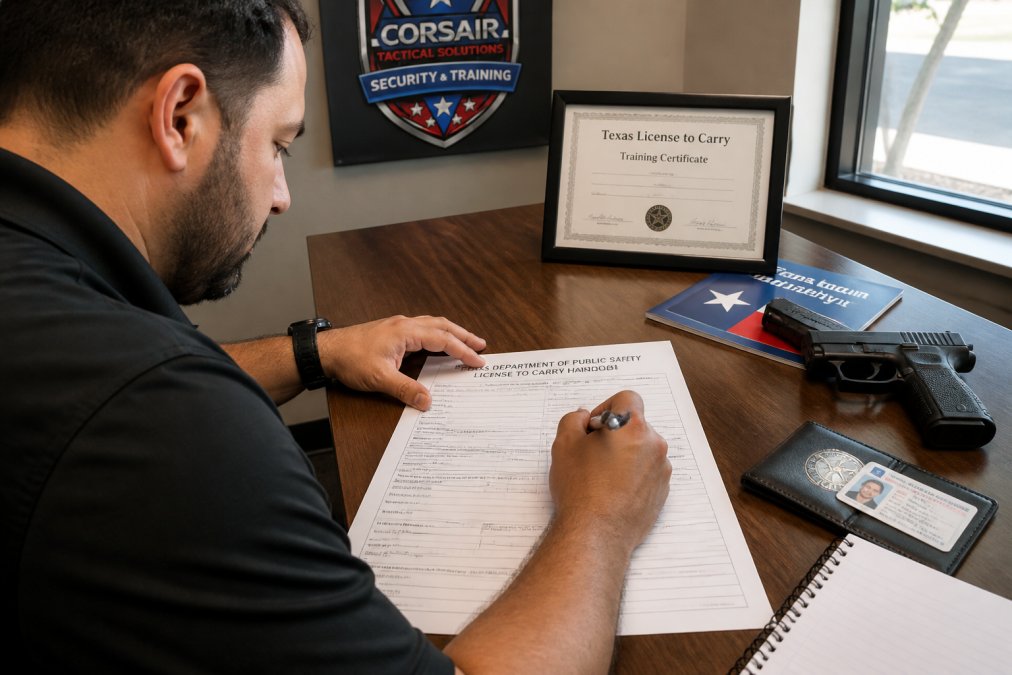
Complete Your Training Certification
Start here. You cannot apply without proof of training.
Find a Texas DPS-certified instructor. Not all gun instructors are certified for LTC training. You need someone approved by the Department of Public Safety. Corsair Tactical Solutions is certified. We offer courses on weekdays and weekends.
Complete the course. It takes four to six hours. You'll spend time in the classroom and on the range. Pay attention to the legal section. That knowledge protects you later.
Get your certificate. The instructor provides a completion certificate. Keep it safe. You'll need it for your application. Some instructors mail it. Others give it to you same day.
Verify the instructor's credentials. Check the Texas DPS website for certified instructors. Make sure your instructor is listed. A certificate from an uncertified instructor won't work.
Gather Required Documentation
You need several documents for your application. Collect them before you submit.
Your training certificate is essential. This proves you completed the course.
A valid Texas driver's license or ID card is required. It must be current. If your license is expired, renew it first.
Proof of Texas residency is needed. A utility bill, lease agreement, or mortgage statement works. It must show your name and address. It should be recent (within 90 days).
If you're active military, bring military ID and orders showing Texas assignment.
If you've lived in Texas less than six months, bring proof from your previous state showing residency there. Texas wants a continuous residency record.
Gather any documents related to name changes. If you've been divorced or married, bring the paperwork. Your application name must match your ID exactly.
Make copies of everything. Keep originals for your records. Submit copies with your application.
Submit Your Application to Texas DPS
The Texas Department of Public Safety handles all LTC applications. You apply through their licensing division.
Visit the Texas DPS website. Find the License to Carry section. Download the application form or apply online. The online system is faster and more reliable.
Fill out the application completely. Answer every question. Be honest about your criminal history and mental health. Lying on the application is a felony.
Include your training certificate copy. Attach a copy of your ID. Include proof of residency.
Pay the application fee. Texas charges a fee for processing. Current fees vary. Check the DPS website for the exact amount. You can pay by credit card online or by check if mailing.
Submit online or mail your application. Online submission is faster. If you mail it, send everything to the Texas DPS License to Carry office in Austin. Keep a copy of everything you send.
Wait for Processing and Approval
The DPS processes applications in order. Most approvals take 30 to 60 days. Some take longer if they need more information.
You'll receive a confirmation email or letter.
Common Mistakes to Avoid When Applying
Most rejections happen because applicants miss details. Avoid these common errors.
Getting Certified Training Near You
Finding the right training is crucial. Your instructor shapes your knowledge and skills.
Frequently Asked Questions
Do I need a license to carry a handgun in Argyle, Texas?
Texas allows constitutional carry, meaning you can carry a handgun without a License to Carry (LTC). However, obtaining an LTC provides legal advantages, including reciprocity in other states and simplified background checks. Many responsible gun owners choose to get an LTC for these benefits and to demonstrate their commitment to proper training and compliance.
What are the eligibility requirements for a Texas License to Carry?
You must be at least 21 years old (18 if active military), a U.S. citizen or legal permanent resident, a resident of Texas, and have no disqualifying criminal history or mental health adjudications. You cannot be subject to protective orders or have certain felony convictions. Texas LTC requirements also mandate completion of a certified training course covering firearm safety and operation.
How long does the Texas LTC course take to complete?
The Texas LTC course typically takes 4 to 6 hours to complete, depending on the instructor and course structure. The course covers firearm safety, laws governing use of force, and practical shooting fundamentals. Upon completion, you receive a certificate required for your LTC application.
What's the difference between constitutional carry and getting an LTC in Texas?
Constitutional carry allows you to carry a handgun without a permit, while an LTC is a formal permit issued by Texas DPS. With constitutional carry, you can carry openly or concealed without a license. An LTC, however, provides reciprocity in other states, streamlines background checks, and demonstrates formal training. Many choose an LTC for these practical and legal advantages despite constitutional carry being available.