 blog
blog
Find Active Shooter Training in Texas: 2026 Guide
Table of Contents
- What Texas Requires from Certified Active Shooter Training Providers
- Active Shooter Response Training Curriculum Requirements to Look For
- How to Evaluate Security Training Providers Before You Enroll
- Active Shooter Response Training Duration: What to Expect
- Train-the-Trainer Programs and Single-Officer Response Tactics
- Vetting Private Providers: Cost, Maintenance, and Red Flags
- Frequently Asked Questions
Last Updated: September 11, 2026
What Texas Requires from Certified Active Shooter Training Providers
Finding a certified security training provider in Texas that focuses on active shooter training starts with understanding who actually regulates the field. The Texas Department of Public Safety (DPS) oversees private security licensing through its Private Security Bureau, and any provider claiming state certification must hold current DPS approval. This guide from Corsair Tactical Solutions walks through the licensing, curriculum, and vetting standards that separate legitimate programs from marketing claims.
The Texas DPS Private Security Bureau maintains the official registry of licensed schools and instructors. Before you enroll anywhere, verify the provider appears in that registry. A certificate from an unlicensed school carries no weight with employers, insurers, or courts.
Texas DPS Licensing and Peace Officer Certification Standards
Texas DPS licensing is the baseline credential for any active shooter training provider operating in the state. Instructors must hold a valid license, and schools must meet facility, insurance, and record-keeping requirements.
Peace officer certification matters differently. Active and retired peace officers bring field experience that civilian instructors often lack, but their certification alone doesn't make them good teachers. What most guides miss is that the best programs combine sworn-officer experience with formal instructional credentials.
Private Security Bureau Oversight and Compliance Requirements
The Private Security Bureau audits training records, investigates complaints, and can revoke licenses. Compliance requirements include documented lesson plans, instructor-to-student ratios, and continuing education for trainers.
Ask any provider for their DPS license number and their most recent compliance history. A provider that hesitates on either question is telling you something.
Active Shooter Response Training Curriculum Requirements to Look For
A credible active shooter response training curriculum covers three things: how to recognize a threat before it escalates, how to respond when it does, and how to keep people alive afterward. Programs that skip any of those three leave gaps you'll discover at the worst possible moment.
Situational Awareness and Threat Identification Modules
Situational awareness training teaches participants to notice pre-incident indicators: unusual behavior, unauthorized access attempts, and environmental cues that something is wrong. Threat identification modules build on that foundation by showing how to assess and report concerns before they become emergencies.
Look for hands-on training here, not lecture-only delivery. Watching a video about threat assessment is not the same as practicing it under stress.
Lifesaving Medical Skills and Bleeding Control Integration
Bleeding control and tourniquet application belong in every active shooter preparedness course. The period between an incident and the arrival of emergency medical services is when preventable deaths happen, and civilians who know how to apply a tourniquet correctly can change that outcome.
How to Evaluate Security Training Providers Before You Enroll
Most guides tell you to "check credentials" without explaining how. This section walks through the actual verification steps for private, non-governmental providers, the gap most government and academic resources leave open.
Step 1: Verify the DPS License, Not Just the Claim
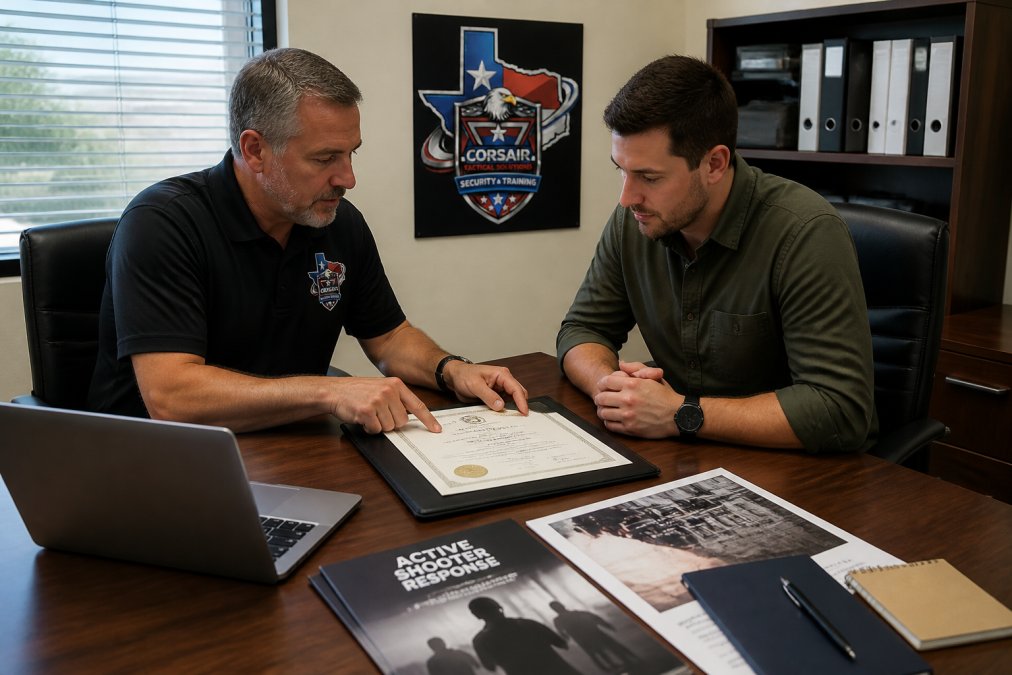
The Texas DPS Private Security Bureau maintains a public registry of licensed schools and instructors. Ask the provider for their license number in writing, then look it up yourself. Confirm three things: the license is active, the license type matches the training being sold (a school license is not the same as an instructor license), and the name on the license matches the entity you are paying. A common pattern is a sales entity that is separate from the licensed school, that is not automatically a problem, but you should know which entity carries the license and which one carries the liability.
Step 2: Read the Compliance History
The Private Security Bureau audits training records and investigates complaints. Ask the provider whether any complaints have been filed against their license in the last three years and whether any resulted in disciplinary action. A provider with a clean history will answer directly. A provider that deflects, or that claims complaints are "private," is telling you something. You can also request the public disciplinary records directly from the Bureau.
Step 3: Separate Field Experience from Instructional Credential
Peace officer certification and instructor certification are different things. A retired officer with twenty years on the street may have no formal instructional training, and a certified instructor may have never responded to a real incident. The strongest programs pair both: a lead instructor with documented field response experience and a formal instructor credential, plus a co-instructor or assistant who can run scenario drills safely. Ask for instructor bios that list both, and ask how many students each instructor has trained in the last twelve months.
Step 4: Pressure-Test the Curriculum
Request the full lesson plan, not a marketing outline. Look for three things: a written scenario component (not just lecture), a documented medical module with hands-on tourniquet practice, and a stated instructor-to-student ratio for any live drill. A ratio worse than roughly one instructor per fifteen students during scenario work is a red flag, it means students spend most of the drill watching rather than doing.
Step 5: Call References That Match Your Setting
A church, an HOA, a school, and a manufacturing plant have different threat profiles and different legal exposure. Ask for two references from organizations similar to yours in size and setting, and ask those references three questions: Did the training match what was promised? Did the provider adapt to your facility? Would you book them again? A provider that can only produce references from a different sector is a weaker fit.
Step 6: Get the Scope of Work in Writing
Before any deposit, request a written scope of work that itemizes: total hours, classroom vs. hands-on split, medical certification included or not, number of instructors on site, materials provided, certificate type issued, and record retention policy. If the certificate is not issued by a DPS-licensed school, ask what authority backs it. "Certification" that no state agency or recognized national body recognizes is a marketing term, not a credential.
Use this checklist:
- DPS license number verified against the state registry
- License type matches the training being sold
- Complaint and disciplinary history requested
- Instructor bios list both field and teaching experience
- Full lesson plan reviewed, not just an outline
- Instructor-to-student ratio stated for live drills
- Two references from comparable organizations contacted
- Written scope of work itemizing hours, materials, and certificate type
| What to Check | Why It Matters | Red Flag |
|---|---|---|
| DPS license | Legal authority to train | "We're in process" |
| License type | School vs. instructor scope | Vague on which entity is licensed |
| Complaint history | Pattern of problems | Refuses to discuss |
| Instructor credentials | Real field and teaching experience | No bios available |
| Curriculum outline | Complete topic coverage | Vague module list |
| Hands-on hours | Skill retention | Video-only delivery |
| Instructor ratio | Drill safety and reps | No ratio stated |
| Client references | Proven results in your setting | Refuses to share |
| Written scope | Accountability | Pressure to book without one |
Active Shooter Response Training Duration: What to Expect
Active shooter response training duration varies by format, but most comprehensive programs run between four and sixteen hours depending on whether they include medical certification. Shorter sessions cover awareness and evacuation basics; longer ones add bleeding control, scenario drills, and single-officer response tactics.
Emergency preparedness training that fits in a one-hour lunch session has value as an introduction. It is not the same as a full program, and you should not treat it as one.
Train-the-Trainer Programs and Single-Officer Response Tactics
Train-the-trainer programs let organizations build internal capacity by certifying staff to deliver ongoing instruction. This matters because emergency protocols decay without regular drill execution, and bringing an outside instructor back every quarter gets expensive. But not every train-the-trainer program is built the same, and the difference shows up in the second year, not the first.
What a Real Train-the-Trainer Program Includes
A credible program certifies your internal trainers on three layers: the content itself, the delivery method, and the evaluation method. That means your trainers should leave able to teach the material, run a safe scenario drill, and assess whether participants actually retained the skills. Ask the provider how they evaluate your trainers before certifying them, a written exam alone is weak; a teach-back with observation is stronger.
Most programs run two to five days depending on whether medical certification is included. Expect a refresher or recertification requirement, typically annual or biennial, and ask what happens if your certified trainer leaves the organization. The best providers allow a replacement trainer to be certified at a reduced rate, which protects your investment.
Building a Maintenance Schedule That Actually Holds
A single session fades within months without reinforcement. The strongest programs include annual refreshers, updated emergency action plans, and periodic walkthroughs of your actual facility. A practical schedule looks like this: full initial training for all staff, a quarterly tabletop or walkthrough drill led by your internal trainer, an annual hands-on refresher with an outside instructor, and a full curriculum update every two to three years or whenever your facility layout, staffing, or threat profile changes.
Single-Officer Response Tactics: What Civilians Need to Understand
Single-officer response tactics apply mainly to law enforcement and armed security personnel, but civilians benefit from understanding the framework. When a lone officer arrives during an active threat, they are trained to move toward the threat immediately rather than wait for backup. That doctrine, sometimes called solo active shooter response, shapes how the officer moves, what they shout, and how they interpret your behavior.
For civilians, the practical takeaways are narrow but important. First, when law enforcement arrives, your hands should be visible and empty. Second, do not run toward an officer who is moving toward the threat, you may be mistaken for the threat. Third, follow commands immediately and completely, even if the command seems to conflict with what you were trained to do. Fourth, once you are out of the threat area, expect to be detained briefly until the scene is stabilized. Understanding this sequence reduces the chance that a civilian's panicked reaction is misread as hostile.
How the Two Topics Connect
Train-the-trainer programs are where single-officer response concepts get translated for civilian audiences. Your internal trainers do not need to teach tactical movement, but they should be able to explain what responding officers will do and why, so staff know what to expect in the first sixty seconds after law enforcement arrives. That translation layer is what separates a program that builds capability from one that just delivers information.
Corsair Tactical Solutions builds train-the-trainer options into its Texas DPS-certified security officer training programs, which lets churches, HOAs, and businesses refresh their own teams between formal sessions. The goal is not to replace outside instruction, it is to make the outside instruction stick.
Vetting Private Providers: Cost, Maintenance, and Red Flags
Pricing for active shooter training depends on class size, location, curriculum depth, and whether medical certification is included, so no honest provider quotes a flat number without asking questions first. Request a written proposal that itemizes what's covered.
Post-training maintenance is where most organizations fall short. A single session fades within months without reinforcement. The strongest programs include annual refreshers, updated emergency action plans, and periodic walkthroughs of your actual facility.
Red flags to watch for:
- No DPS license number provided on request
- Curriculum that never mentions bleeding control
- No references from comparable organizations
- Pressure to book without a written scope of work
- Promises of "certification" that no state agency recognizes
A common mistake is choosing a provider based on price alone. The gap between a generic workplace violence prevention seminar and a real active shooter preparedness course is the difference between information and capability.
Active shooter training only matters if it holds up under pressure, and that requires a provider who understands both instruction and real-world response. Corsair Tactical Solutions brings 14 years of instructing experience, a veteran-led team, and the 4D Protection Model™ to churches, HOAs, and businesses across Texas. Our DPS-certified programs cover situational awareness, bleeding control, and hands-on scenario work, with train-the-trainer options that keep your team sharp year after year. Schedule a consultation with Corsair Tactical Solutions and build a preparedness plan that actually works when it counts.
Frequently Asked Questions
How do I verify if a security training firm is state-certified in Texas?
Check the Texas Department of Public Safety (DPS) website for the Private Security Bureau's list of licensed training providers. Ask for their DPS license number and verify it online. A legitimate provider will also carry liability insurance and be bonded. Corsair Tactical Solutions, for example, is Texas DPS-certified for Level II, III, and IV training. Always confirm the certification is current and matches the specific courses you need.
What should be included in a comprehensive active shooter response curriculum?
A strong curriculum covers situational awareness, threat identification, evacuation procedures, lockdown strategies, and hands-on bleeding control with tourniquet application. It should also include incident command basics and drill execution. Look for courses that blend classroom instruction with realistic scenarios. The curriculum must meet Texas DPS standards for private security training and align with your organization's emergency action plan. Ask for a detailed syllabus before enrolling.
How often should an organization conduct active shooter refresher training?
Most safety experts recommend annual refresher training, with quarterly tabletop exercises or walkthroughs. High-turnover environments or large venues may need more frequent sessions. After any real incident or major staff change, schedule additional training. Texas DPS requires continuing education for security officers, but organizational readiness depends on regular practice. Post-training maintenance like refreshers and drills keeps skills sharp and ensures your emergency protocols stay current.
Are there specific training standards for private security firms versus law enforcement?
Yes. Law enforcement follows Texas Commission on Law Enforcement (TCOLE) standards, which include peace officer certification and advanced tactical training. Private security firms operate under Texas DPS Private Security Bureau rules, with Level II, III, and IV certifications. While both cover active shooter response, private providers focus on civilian response protocols, workplace violence prevention, and protecting clients. Some private instructors, like Corsair Tactical Solutions, also hold TCOLE or NRA certifications, bridging both worlds.