 ultimate-guide
Armed Security for HOA Communities: A 2026 Guide
Table of Contents
- Why Armed Security Matters for HOA Communities
- Armed vs Unarmed Security Guards for Residential Properties
- Legal Requirements and Licensing for Armed Security Officers
- Security Threat Assessment for Residential Neighborhoods
- HOA Security Liability Insurance and Risk Management
- Coordinating Armed Security with Local Law Enforcement
- Implementing Armed Security: Access Control and Patrol Strategy
- Conclusion
- Frequently Asked Questions
Last Updated: October 2, 2026
Why Armed Security Matters for HOA Communities
A growing number of residential associations are shifting to armed security for HOA communities, reflecting real assessments of neighborhood risks, liability exposure, and response capacity.
Traditional unarmed security deters petty crime but cannot stop active threats. Armed security for HOA communities changes that: trained, certified armed officers identify threats early, establish defensive perimeters, and respond with proportional force when necessary.
HOA boards carry fiduciary duty to protect common areas and respond to emergencies. Inadequate security creates liability exposure that can exceed staffing costs by orders of magnitude. Many insurance carriers now require or incentivize armed security for larger or higher-crime communities.
Armed security for HOA communities signals commitment to resident safety, improves resident confidence, and dramatically improves emergency outcomes.
Armed vs Unarmed Security Guards for Residential Properties
Unarmed officers excel at access control, routine patrol, and documentation. For small, low-crime communities, unarmed patrol often suffices at lower cost and minimal liability. However, unarmed guards cannot stop armed intruders.
Armed officers undergo background checks, firearms certification, and ongoing training in use-of-force policy and de-escalation. They identify and neutralize active threats, establish perimeter security, and coordinate with law enforcement. The trade-off is higher cost, stricter licensing, and elevated liability if force is used improperly.
Most mid-to-large communities benefit from a hybrid approach: unarmed officers for routine patrol and access control, with armed personnel for higher-threat situations or overnight shifts.
If your community faces only petty theft or trespassing, unarmed security is adequate. If threats include vehicle break-ins, home invasions, or active threats, armed capability becomes essential. A professional risk assessment by someone with actual security expertise is critical.
Legal Requirements and Licensing for Armed Security Officers
Every armed security officer operating in residential settings must hold a valid security guard license and firearms certification. The specifics vary by state, but the pattern is consistent: background checks, training documentation, and ongoing compliance.
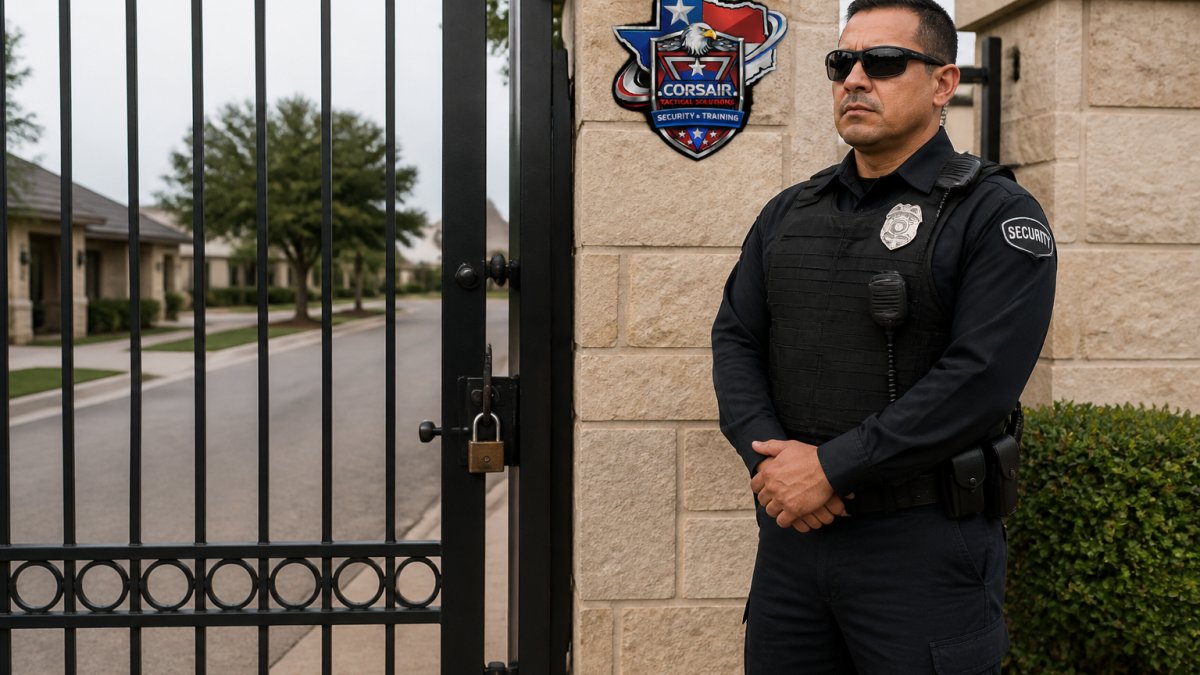
In Texas, armed security officers must obtain a Level II, III, or IV license through the Department of Public Safety, each requiring documented training hours, exam passage, and liability insurance proof. Level III adds armed patrol authority; Level IV includes supervisor credentials. Licensing ensures minimum competency and accountability.
Firearms certification is separate from security licensing and requires annual recertification or regular training updates, demonstrating proficiency, use-of-force law knowledge, and judgment in high-stress scenarios.
HOA boards must verify every armed officer's credentials before deployment: current licenses, certifications, background clearance letters, liability insurance, and bonding. This demonstrates due diligence in hiring decisions.
The board remains liable if an officer lacks proper credentials or if the company fails to maintain required insurance. Verify independently with any provider before signing a contract.
Security Threat Assessment for Residential Neighborhoods
A professional assessment examines crime data, resident demographics, recent incidents, and physical vulnerabilities to identify exposed areas, high-risk times, and likely threat types.
A gated community in a low-crime suburb faces different threats than an open-entry community near a highway with rising property crime. The first may need armed security for deterrence; the second may need 24/7 patrol and enhanced access control.
A threat assessment clarifies which security model addresses identified risks. If incidents cluster during evening hours, overnight patrol becomes a priority. If break-ins concentrate in poorly lit areas, lighting and cameras may be more cost-effective than additional staffing.
The assessment should be conducted by someone with real security credentials, law enforcement, military, or professional risk management background, not a sales representative. The goal is matching capability to actual risk, not overselling.
HOA Security Liability Insurance and Risk Management
Many boards mistakenly assume that hiring a security company transfers liability to the contractor. It doesn't.
The board retains liability for hiring armed security, selecting the provider, and overseeing service. If an armed officer uses excessive force or fails to respond appropriately, the association can be sued alongside the officer and company. Insurance is critical.
How Armed Security Affects Your Master Policy
Most HOA master liability policies are written with standard premises liability and management liability coverage. When armed security is introduced, the underwriting profile changes. Insurers view armed personnel as a material increase in risk exposure because use-of-force incidents carry higher settlement and judgment costs than typical premises liability claims.
Before deploying armed security, notify your insurance broker in writing. Many policies exclude incidents involving firearms or armed personnel, and some require prior written approval. Failure to notify can result in claim denial.
The notification process typically triggers a policy review. The insurer may request a security plan, require additional coverage, adjust premium rates (typically 5-15% or flat fees of $500-$2,000 annually), or impose conditions such as background checks or coordination agreements with local law enforcement.
Some insurers will decline to renew or exclude armed security. If your insurer refuses coverage, switch to a carrier specializing in higher-risk properties. Initiate this 60-90 days before deployment.
Liability Layers and Certificate of Insurance
The security company must carry general and professional liability insurance with the HOA named as additional insured. This creates a second layer of protection if the company is sued for guard misconduct.
Verify policy limits: minimum $1 million per occurrence and $2 million aggregate for armed security. Anything below $1 million leaves the HOA exposed to uninsured portions of judgments.
Confirm the security company's policy includes bodily injury and property damage caused by armed officers, employment practices liability, and errors and omissions coverage.
Request updated certificates annually.
Risk Management Beyond Insurance
Insurance is a financial backstop, not a substitute for operational controls. Risk management means establishing clear protocols that prevent incidents.
Contractual Protections
Include indemnification, background check requirements, immediate removal clauses, insurance maintenance obligations, and termination-for-convenience language in the security service agreement.
Coordinating Armed Security with Local Law Enforcement
Before deploying armed security, notify local law enforcement with the community's address, security company contact information, and patrol schedule. This prevents surprise encounters and reduces miscommunication during emergencies.
Implementing Armed Security: Access Control and Patrol Strategy
Deploying armed security for HOA communities requires more than hiring officers. It requires a strategy that addresses access control, patrol frequency, incident response, and, critically, resident communication.
Access Control Foundation
Access control is the foundation of armed security. Armed officers manage entry points, verify resident ID, log visitors, and prevent unauthorized access. Larger communities may use staffed gatehouses; smaller ones use roving patrols.
Patrol Strategy and Coverage
Patrol strategy depends on community layout and threat assessment. Strategic patrols during high-risk hours (evenings, weekends, late night) provide good coverage at reasonable cost, emphasizing parking lots, recreational facilities, perimeter access points, and low-visibility areas.
Communicating Armed Security to Residents
Residents have legitimate concerns about armed personnel: accidents, excessive force, militarized atmosphere, or signals of danger affecting property values. Without proactive communication, these concerns fester into opposition and legal challenges.
Managing objections:
- "This makes our community look dangerous." Response: Armed security is standard in many safe, affluent communities. It signals that the board takes security seriously, not that the neighborhood is unsafe. Property values are more affected by actual crime than by the presence of security.
- "Armed officers will overreact and hurt someone." Response: Our officers are trained in de-escalation and use-of-force law. They carry liability insurance and are accountable for misconduct. We have clear protocols that prioritize non-lethal alternatives.
- "This is too expensive." Response: The cost of a single home invasion or violent crime, in terms of resident trauma, property damage, and potential liability, far exceeds the annual cost of armed security. Insurance carriers often reduce premiums when armed security is deployed, offsetting some costs.
- "Why not just hire more police?" Response: Police response times in our area average 8-12 minutes. Armed security provides immediate presence and can de-escalate or contain situations before police arrive. They complement police, not replace them.
Post-deployment communication:
After armed security is deployed, maintain resident engagement:
- Share incident summaries (without identifying residents) to show that the program is working.
- Invite residents to provide feedback on officer conduct and service quality.
- Adjust protocols based on resident input if appropriate.
- Celebrate successes: if armed security prevents a crime or responds effectively to an incident, communicate that to the community.
Conclusion
Armed security for HOA communities is not a luxury, it's a liability management decision. When a community faces genuine threats, when the board has fiduciary duty to residents, and when the cost of an incident far exceeds the cost of prevention, armed security becomes the rational choice.
Frequently Asked Questions
What are the legal liabilities for HOAs hiring armed security?
HOA boards face liability if armed security personnel act negligently, use excessive force, or violate resident rights. Boards must ensure security officers are properly licensed, trained, and insured. Liability insurance is critical, it protects the HOA from lawsuits arising from security incidents. Many insurers require documented threat assessments, written use-of-force policies, and proof of officer certification before approving armed security coverage. Consult your liability carrier before deploying armed personnel.
How does armed security differ from standard patrol services in residential areas?
Armed security officers carry firearms and have expanded authority to respond to active threats, while unarmed patrol focuses on access control, surveillance, and incident reporting. Armed officers can intervene in violent situations; unarmed staff typically contact law enforcement and de-escalate. Armed deployment requires higher training standards, licensing, background checks, and stricter insurance requirements. The choice depends on threat level, community size, and budget, smaller HOAs often start with unarmed patrol and escalate if risk assessment warrants armed presence.
What should an HOA board look for in a security threat assessment?
A comprehensive security threat assessment evaluates crime rates in your neighborhood, previous incidents at your property, resident demographics, entry points, surveillance gaps, and emergency response times from local law enforcement. The assessment should identify specific vulnerabilities, poorly lit common areas, weak gate access controls, or blind spots, and recommend proportional solutions. A professional threat assessment informs whether armed security is necessary or if access control and surveillance upgrades would suffice. This document also strengthens your liability insurance application and demonstrates due diligence to residents.
How do you communicate armed security plans to HOA residents?
Transparency builds resident confidence and reduces liability exposure. Notify residents in writing before deploying armed security, explaining the threat assessment findings, the specific role of armed officers, their training credentials, and community safety protocols. Host a resident meeting to address concerns and answer questions. Share the use-of-force policy and emergency contact procedures. Document all communications. Residents who understand the rationale for armed security are less likely to file complaints or resist officer presence, and this record demonstrates that the board acted responsibly if a legal challenge arises.