 listicle
7 Ways to Improve HOA Property Security
Table of Contents
- 1. Start With a Residential Community Security Assessment
- 2. Hire Professional HOA Security Guard Services in Texas
- 3. Improve Lighting and Landscaping to Remove Cover
- 4. Install and Manage Security Cameras Within HOA Security Camera Regulations Texas
- 5. Control Access at Gates and Common Areas
- 6. Train Residents and Staff to Recognize and Report Threats
- 7. Build a Layered Security Plan to Improve HOA Security
- Frequently Asked Questions
Last Updated: September 13, 2026
1. Start With a Residential Community Security Assessment
A residential community security assessment is a structured walkthrough of your property that maps every access point, blind spot, and response gap before you spend a dollar on hardware or personnel. It is the foundation of the 7 ways to improve HOA property security, and skipping it is the most common mistake boards make.
Most boards react to a single incident, a car break-in or a package theft, by buying cameras. That is backwards. The assessment tells you what to protect and in what order.
A thorough assessment covers four areas:
- Perimeter and entry points: gates, fences, pedestrian paths, retention ponds
- Common areas: clubhouse, pool, mail kiosk, playground, fitness room
- Lighting and sightlines: which corridors go dark, which hedges block views
- Response protocols: who residents call, how fast anyone actually arrives
Boards that document findings in writing tend to make better budget decisions, because they can rank fixes by risk rather than by whoever complained loudest at the last meeting.
2. Hire Professional HOA Security Guard Services in Texas
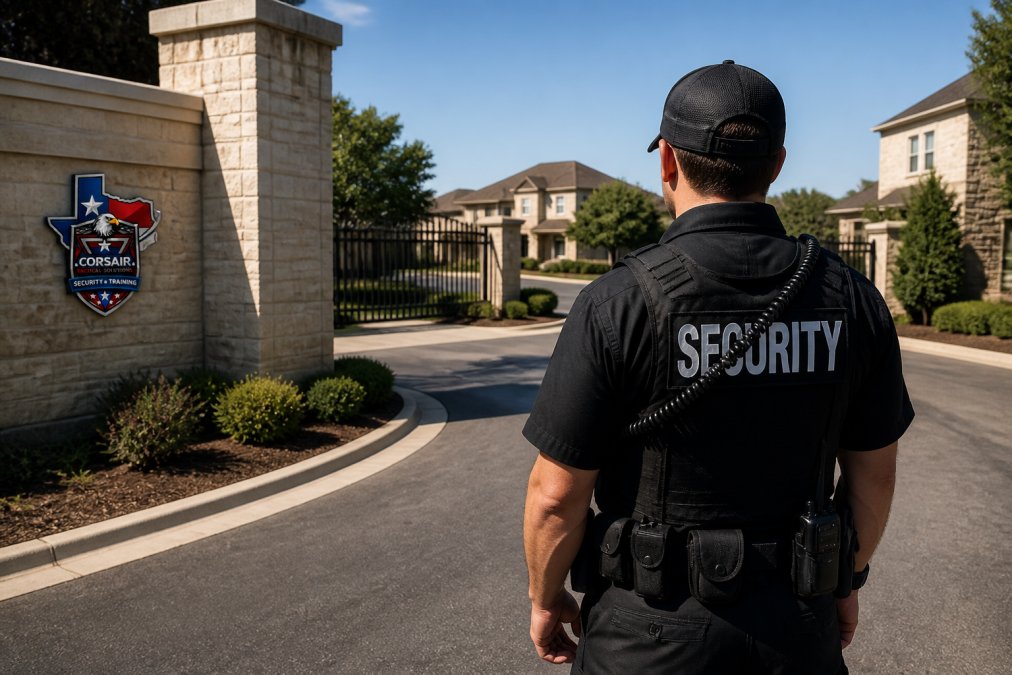
Uniformed patrol coverage is the fastest way to change how a community feels to both residents and outsiders. Professional HOA security guard services in Texas give you trained, documented officers who log activity, enforce community rules, and act as a visible deterrent rather than a passive camera feed nobody reviews.
What separates a useful patrol from a wasted contract comes down to three things: training, reporting, and consistency. Ask any provider how officers are certified, what their post orders look like, and how incidents reach the board. If the answer is vague, keep looking.
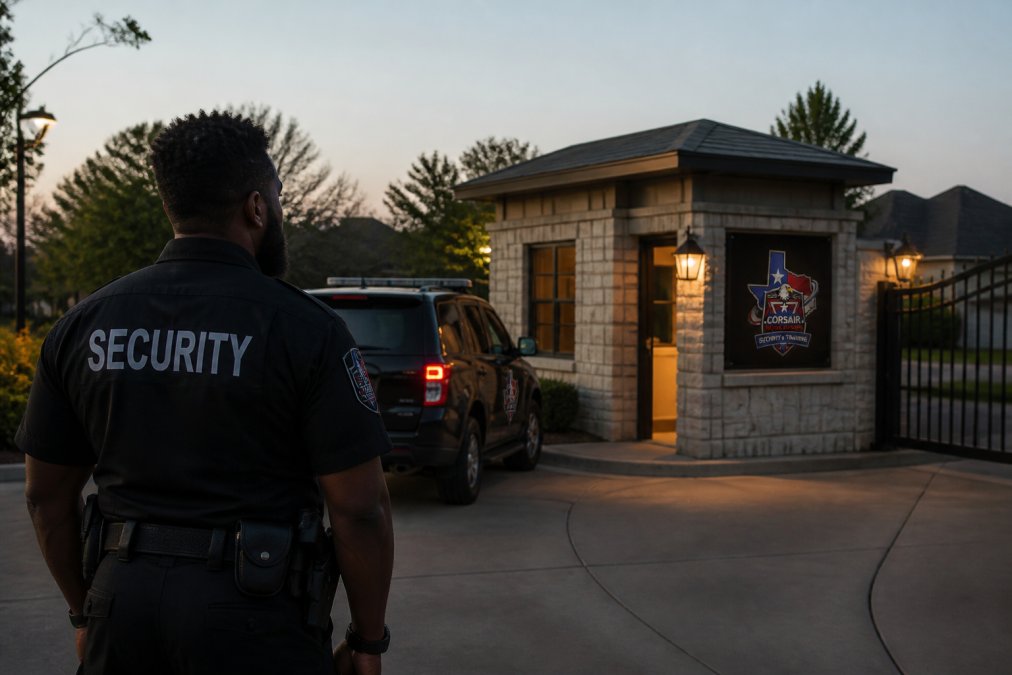
Corsair Tactical Solutions provides armed and unarmed security patrol for HOA properties, built on a veteran-led team with more than 14 years of instructing experience. Officers work from written post orders, and the firm's 4D Protection Model™ gives boards a repeatable framework instead of ad hoc coverage. As a licensed, bonded, and insured provider, Corsair Tactical Solutions also runs HOA security audits, which pairs well with the assessment in step one.
3. Improve Lighting and Landscaping to Remove Cover
Lighting and landscaping are the cheapest security upgrades available, and boards routinely overlook both. Criminals avoid well-lit, open ground (How Do We Know It Works? Conducting a Rapid Research Police Experiment To Test the...). They gravitate to dark corners and dense shrubs where they can work unobserved.
Start with a lighting audit. Replace burned-out fixtures, add motion-activated lights at side entrances and mail areas, and check that pool and clubhouse lighting stays on through the evening. Then trim. Keep shrubs below window height, raise tree canopies so they do not create shadowed tunnels over walkways, and clear sightlines from the street into common areas.
The goal is simple: anyone standing in your community should be visible from multiple points. When you remove cover, you remove opportunity.
4. Install and Manage Security Cameras Within HOA Security Camera Regulations Texas
Cameras are evidence tools, not deterrents on their own. HOA security camera regulations in Texas matter here: private communities are generally governed by Texas property law and, in many cases, deed restrictions rather than a single statewide camera statute, so boards should confirm their authority in the community's covenants before installing anything.
Placement matters more than resolution. Prioritize:
- Vehicle and pedestrian gates
- Clubhouse and pool entries
- Mail and package areas
- Parking lots and trash enclosures
Then manage what you install. Cameras that record but are never reviewed provide no protection. Set a retention schedule, assign someone to check footage after incidents, and post signage so residents know they are on camera.
Texas State Law Library guide to property and homeowner association law is a reasonable starting point for boards checking what their covenants and state law actually permit.
5. Control Access at Gates and Common Areas
An open gate undoes everything else on this list. Access control means knowing who enters, when, and why, and it applies to gates, clubhouse doors, pool areas, and fitness rooms alike.
Practical controls include keypad or fob entry with deactivated credentials for former residents, visitor logs at the gatehouse, and a policy for vendors and contractors. For communities with a guard force, that means officers verify deliveries and log unfamiliar vehicles rather than waving them through.
The hard part is enforcement. Boards that let residents prop gates open or share codes with guests quietly erase their own access control. Set the rule, communicate it, and hold the line.
6. Train Residents and Staff to Recognize and Report Threats
Your residents are the largest sensor network you have, and most communities never train them. A short annual briefing on what to watch for, who to call, and how to report without escalating a situation pays for itself.
Cover the basics: unfamiliar vehicles circling, people photographing entry points, packages taken from porches, doors left unsecured. Give residents one clear reporting channel, whether that is a patrol number, an app, or a direct line to the board's security contact.
Staff need more. Front desk and maintenance personnel should know how to handle a trespasser, when to call law enforcement, and what to document. Corsair Tactical Solutions runs church safety audits and training programs built on the same principle: prepared people respond better than surprised people.
7. Build a Layered Security Plan to Improve HOA Security
No single measure secures a community. The boards that sleep well combine assessment, staffing, lighting, cameras, access control, and trained people into one plan where each layer covers the gaps in the others.
Layering works because it removes single points of failure. If a camera goes down, patrols still cover the area. If a gate fails, lighting and sightlines still expose intruders. If a resident forgets to report something, the next layer catches it.
Document the plan, assign owners for each layer, and review it annually. Security is not a purchase. It is a maintained system.
| Layer | What It Covers | Who Owns It |
|---|---|---|
| Assessment | Risk mapping and priorities | Board / security consultant |
| Guard services | Visible deterrence and response | Contracted provider |
| Lighting and landscaping | Removes concealment | Landscaping and maintenance |
| Cameras | Evidence and after-hours monitoring | Board / property manager |
| Access control | Entry management | Gatehouse / management |
| Resident training | Reporting and awareness | Board / security provider |
The 7 ways to improve HOA property security amount to a coordination problem, not a hardware problem, and most boards underestimate how much the layers depend on each other. Corsair Tactical Solutions helps Texas communities build that system from the ground up, with HOA security audits, armed and unarmed patrol, and a veteran-led team that has trained hundreds of students. The firm's 4D Protection Model™, licensed and insured coverage, and 14-plus years of instructing experience give boards a partner who can assess, staff, and maintain a layered plan. Schedule a consultation with Corsair Tactical Solutions and get a security plan your residents can actually rely on.
Frequently Asked Questions
What are the legal responsibilities of an HOA regarding security in Texas?
Texas law does not require HOAs to provide security, but once an HOA assumes a duty, it must act without negligence. HOAs can be held liable for foreseeable criminal acts if they fail to maintain safe common areas. To reduce risk, document all security policies, train staff, and consult legal counsel. A professional residential community security assessment can identify gaps and help establish reasonable care standards.
How can HOAs in Argyle, TX, effectively deter property crime?
Deterrence in Argyle starts with visible, consistent security measures: uniformed patrols, well-lit streets, and working cameras. Remove hiding spots by trimming landscaping. Encourage residents to report suspicious activity through a dedicated hotline. Partner with local law enforcement for extra patrols during peak times. These steps increase the perception of risk for offenders and have been shown to reduce property crime in residential areas.
Should HOAs hire private security firms or rely on local law enforcement?
Local law enforcement responds to calls but cannot provide dedicated patrols for your community. Private HOA security guard services in Texas offer consistent presence, faster response to non-emergencies, and enforcement of community rules. They also act as additional eyes and ears for police. Many HOAs combine both: private guards handle access control and patrols, while police handle emergencies. This layered approach improves overall safety.
What is the 4D Protection Model for residential community security?
The 4D Protection Model is a proprietary framework developed by Corsair Tactical Solutions. It stands for Deter, Detect, Delay, and Defend. Deter uses visible measures like lighting and patrols. Detect uses cameras and alarms. Delay uses physical barriers. Defend involves trained response. This layered approach ensures multiple opportunities to stop an incident. It is customized for each community based on its unique layout and risks.