 blog
blog
5 Best Practices for Church Security Teams in Texas
Table of Contents
- Best Practice 1: Conduct a Threat Assessment and Vulnerability Analysis
- Best Practice 2: Build a Volunteer Safety Team with Clear Roles
- Best Practice 3: Church Security Volunteer Training Requirements
- Best Practice 4: Legal Liability for Church Security Teams in Texas
- Best Practice 5: Use a Church Security Plan Template for Consistency
- Technology and Cybersecurity for Church Security Teams
- Frequently Asked Questions
Last Updated: September 14, 2026
Best Practice 1: Conduct a Threat Assessment and Vulnerability Analysis
A threat assessment evaluates the specific risks your congregation faces; a vulnerability analysis maps where your building and routines leave those risks unaddressed. For church security teams, the assessment comes first because every other decision, from staffing to door locks, depends on knowing what you are protecting against.
Walk your property during a Sunday service, not a quiet Tuesday. Look for unlocked side doors, blind hallways, unmonitored nursery wings, and arrival patterns that put everyone in one place at one time. Most congregations find three to five fixable gaps on the first pass.
How to identify weak points in your building and routine:
- Check every exterior door during services, including fire exits propped open for airflow
- Note sightlines from the welcome desk and parking lot
- Review when children move between rooms and who controls that transition
- Ask ushers where they would hide or exit if someone entered armed
At Corsair Tactical Solutions, our church safety audits follow this same logic: identify the gap, rank it by likelihood and impact, then close it. The CISA guidance on houses of worship security offers a free self-assessment framework that pairs well with a walkthrough.
Best Practice 2: Build a Volunteer Safety Team with Clear Roles
A volunteer safety team is a trained group of congregation members assigned specific security duties during services and events. It works best when every member knows their post, authority, and limits before anything happens.
Start with three roles: greeters watch the door and welcome strangers, observers scan the room and parking lot, and a response lead coordinates with law enforcement and makes the call during an incident.
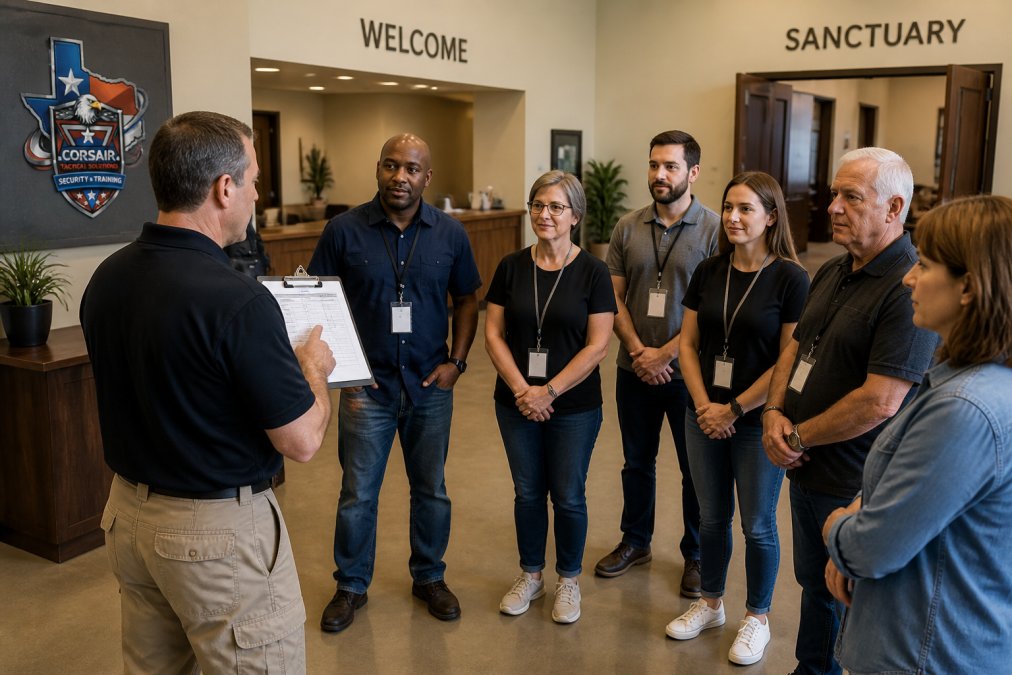
Greeting, observation, and access control protocols:
- Greeters position at every open entrance, not just the main door
- Observers walk a set route every 15 to 20 minutes
- Access control means one monitored entry for visitors during services
- Every team member carries a radio or phone on a shared channel
Clear roles prevent the two most common failures: everyone responding at once, or no one responding because each assumed someone else would act.
Best Practice 3: Church Security Volunteer Training Requirements
Church security volunteer training requirements vary by role, but every volunteer needs baseline instruction in observation, communication, de-escalation, and emergency response before serving. Armed volunteers need substantially more, and in most congregations that role should be reserved for current or former law enforcement, licensed security personnel, or individuals who have completed a state-recognized handgun course and a use-of-force curriculum.
A practical baseline curriculum for unarmed volunteers covers four blocks:
- Situational awareness and observation, how to scan a room, note baseline behavior, and recognize pre-incident indicators (pacing, fixation on entrances, bulky clothing out of season, attempts to bypass the welcome desk).
- Communication and reporting, radio discipline, plain-language descriptions, and the difference between a "suspicious person" report and a "person in crisis" report.
- De-escalation, verbal and nonverbal techniques for reducing tension without physical contact.
- Emergency response, lockdown, evacuation, shelter-in-place, and medical response, including where AEDs and trauma kits are stored.
Most practitioners find a new volunteer needs roughly 8 to 12 hours of initial instruction plus a shadow shift before working a post alone. Armed volunteers typically need 40 or more hours of documented training, including live-fire qualification, judgmental shooting scenarios, and legal instruction on use of force.
De-escalation and Active Shooter Response for Non-Law Enforcement
De-escalation reduces tension through tone, distance, and body language before a situation turns violent. Non-law enforcement volunteers should create space, speak slowly, and call for backup rather than confront. The mechanics that matter most in a church setting:
- Distance and angle. Stay at least two arm-lengths away and off the person's direct line of approach. Never let yourself be cornered between the person and a wall or pew.
- Tone and pace. Lower your volume rather than raising it. Speak in short sentences. Pause between them.
- Reflective listening. Repeat back what you hear ("It sounds like you're saying no one has called you back") before offering any solution. This buys time and lowers arousal.
- The two-question redirect. Ask a simple, answerable question ("Can I get you some water?") to shift the person from emotional to cognitive processing.
- Exit plan. Know your nearest exit and keep it open behind you. Never let a de-escalation attempt trap you in a room.
Active shooter response for volunteers follows the same run-hide-fight framework taught by FEMA's active shooter preparedness resources. The critical difference for churches: volunteers must know the lockdown signal and who gives it, because a sanctuary full of people will not self-organize in seconds. A common pattern is a plain-language code announced over the sound system and repeated by ushers at each aisle, paired with a pre-assigned "door owner" for every exterior door who locks it and stands clear of the glass.
Corsair Tactical Solutions trains church teams through scenario drills, not lectures. Volunteers who have practiced a lockdown once react far faster than those who only read the plan. A useful cadence is one tabletop and one walkthrough per quarter, plus one full live drill per year, with a written after-action note each time.
Best Practice 4: Legal Liability for Church Security Teams in Texas
Legal liability for church security teams in Texas centers on two questions: did the church act reasonably, and did it follow state law on armed personnel? Getting either wrong exposes the congregation to lawsuits and criminal exposure.
What HB 2062 Actually Does
Texas HB 2062, passed in 2017 and effective September 1 of that year, amended the Texas Occupations Code to let churches organize volunteer security teams without those volunteers being classified as licensed security personnel. A church can field a volunteer team, including armed volunteers in some configurations, without running afoul of the state's private security licensing statutes, provided the team meets the statute's conditions.
The conditions that matter most to leadership:
- The team must be organized by the church itself, not contracted from an outside security company.
- Volunteers must not be compensated as security personnel (this is a volunteer role, not employment).
- The team's purpose must be protection of the congregation, not general public security work.
- Armed volunteers must be individually eligible to possess a firearm under state and federal law.
Because the statute has been amended and interpreted since 2017, leadership should review the current text with counsel rather than relying on secondhand summaries. Check the Texas Legislature's official bill record for the exact language and any subsequent amendments.
The Liability Structure You Are Actually Managing
Texas churches generally face three categories of exposure when they field a security team:
- Negligent training or supervision. If a volunteer acts unreasonably and the church cannot show the volunteer was trained, the church is exposed. This is the most common claim and the most preventable.
- Negligent hiring or retention. If a volunteer with a known history of violence or instability is placed on the team, the church can be liable for harm that follows.
- Premises liability. If a foreseeable threat was ignored, for example, repeated trespass warnings that were never documented, the church may be found to have failed its duty to warn or protect.
Texas has no blanket charitable immunity shielding churches from security-related negligence claims. The federal Volunteer Protection Act of 1997 offers some volunteer protections, but they do not cover the church itself and do not apply to willful or criminal misconduct.
Insurance Considerations
- Confirm your general liability policy covers security activities, and get that confirmation in writing.
- Ask whether armed volunteers change your coverage or premiums, many carriers treat armed volunteers as a separate risk class.
- Ask specifically about coverage for use-of-force incidents, which are often excluded under standard general liability policies.
- Document all training, because insurers and courts both ask for it.
- Coordinate with local law enforcement in writing, and keep a copy of the correspondence.
The Honest Limitation
No policy or statute eliminates liability if a team acts recklessly. Reasonable, documented, trained action is your best protection. The three documents that most often decide these cases are the training log, the written security plan, and the incident report, if you have all three and they are consistent, you are in a far stronger position than a church that has none.
Best Practice 5: Use a Church Security Plan Template for Consistency
A church security plan template standardizes roles, procedures, and emergency actions so every volunteer follows the same playbook. Consistency is what holds up under pressure.
A workable plan covers six items:
- Team roster with roles and contact numbers
- Building map with entrances, exits, and camera locations
- Lockdown and evacuation procedures with signals
- Incident reporting form and chain of command
- Training schedule and drill log
- Law enforcement and medical contacts
Emergency Action Plan: Lockdowns, Evacuations, and First-Aid Response
An emergency action plan defines what happens during a lockdown, evacuation, and medical emergency, and who is responsible for each step.
| Emergency | Immediate Action | Who Leads | Key Risk to Avoid |
|---|---|---|---|
| Lockdown | Lock doors, move to safe rooms, stay silent | Response lead | Volunteers searching hallways |
| Evacuation | Guide people to exits away from threat | Greeter team | Congestion at main doors |
| Medical | Call 911, start first aid, clear a path | Designated responder | Crowding the patient |
| Suspicious person | Observe, report, do not confront | Observer | Untrained physical contact |
First-aid response deserves its own training: several volunteers should hold current CPR and stop-the-bleed certification, and the church should keep an AED accessible and maintained.
Corsair Tactical Solutions builds these plans with church leadership so the document matches the building, the congregation size, and the volunteers who will actually execute it.
Technology and Cybersecurity for Church Security Teams
Cameras and access control help only when someone watches the feed and the doors actually lock. A system that records but is never monitored catches evidence after an incident, not the incident itself.
Access control matters more than cameras for most congregations. Keypad entry on staff and children's areas, plus a single monitored visitor entrance, closes the gaps a walkthrough usually finds.
Cybersecurity is the gap most churches ignore. Your database holds member addresses, giving records, and children's check-in data, so a breach exposes families and creates legal exposure. Use unique passwords, enable two-factor authentication, and limit who can export member data.
CISA's cybersecurity resources for small organizations offers free, practical guidance built for organizations without an IT department.
Church security teams face a real challenge: threats are rare enough to breed complacency and serious enough that complacency is costly. A team that identifies risk early, trains consistently, and follows a written plan changes your congregation's odds when it matters most. Corsair Tactical Solutions supports churches across Texas with church safety audits, scenario-based training, and our proven 4D Protection Model™, delivered by a veteran-owned team with 14+ years of instructing experience. Schedule a consultation with Corsair Tactical Solutions and give your congregation a security plan built for the building you actually worship in.
Frequently Asked Questions
What are the legal requirements for volunteer security teams in houses of worship in Texas?
Texas law does not mandate specific training for volunteer security teams, but churches must comply with HB 2062 if using armed volunteers. This law requires the church to have a written security policy, volunteers must hold a valid License to Carry (LTC), and they must complete a state-approved training program. Unarmed volunteers have no state training requirement, but churches should still provide documented training to reduce liability.
How do we create a church security plan template that fits our congregation?
Start with a template that includes a threat assessment, roles and responsibilities, communication protocols, emergency action steps, and a training schedule. Customize it to your building layout, service times, and congregation size. Corsair Tactical Solutions offers a customizable church security plan template as part of their consultation services, which can be adapted for any size congregation.
What training is required for church security personnel in Texas?
For unarmed volunteers, Texas has no state-mandated training, but best practices include de-escalation, situational awareness, first-aid/CPR, and emergency response drills. For armed volunteers, HB 2062 requires a valid LTC and completion of a state-approved training program, such as the Texas DPS-certified Level III armed security officer course. Corsair Tactical Solutions provides this training and can tailor it to church settings.
How can churches implement the 4D Protection Model™?
The 4D Protection Model™ is a proprietary framework by Corsair Tactical Solutions that stands for Deter, Detect, Defend, and Defuse. Churches can implement it by scheduling a consultation with Corsair Tactical Solutions, who will assess your current security posture and develop a layered plan. This includes physical security measures, volunteer training, and coordination with local law enforcement.